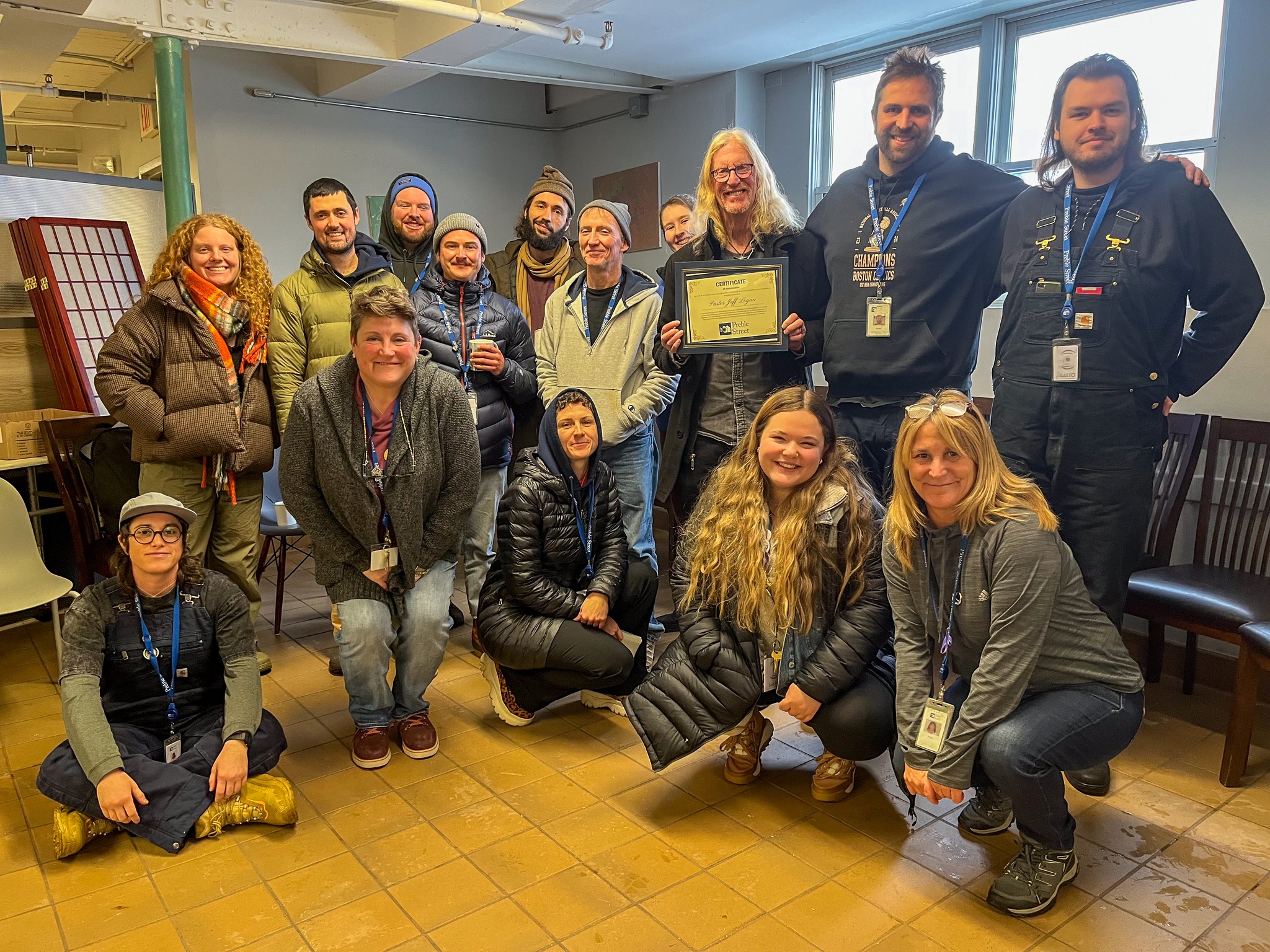
Share a little bit about yourself and what brought you to the work you’re doing today.
I was ordained by Chaplaincy Institute of Maine in 2015, and as luck would have it, there was a position of co-pastor available at Grace Street Ministry. In 2019, I became the Executive Director. We’re tiny, just three co-pastors on the street. We basically serve this community with presence, prayer, and advocacy – that’s our mission statement. Presence is 99.9% of it. We show up every day and every week, and we come with small things. My car is recognizable. I’m recognizable. So people will stop me and ask, “Do you have boots? Do you have socks?” But that’s only really a way of building trust, and people are very understanding when you don’t have things. I’m not there to solve all the problems that people have. What we’re there to do is basically just listen without judging and to offer what level of connection to the divine that people are interested in, or not.
In recent years, as resources dwindle and as housing and shelter space become more scarce, that building of connection and of just seeing someone and listening is a big part of what Preble Street case workers can give. It’s incredible what a difference it makes when people who are struggling know someone is in their corner, and that they’re not alone.
Exactly, and that connection is an important part of the work. I assist Preble Street with food distribution to unsheltered people, and was with Peggy (Preble Street Outreach Supervisor) there the other day. There was a woman who was newly homeless, and Peggy began talking to her about shelter and other resources. If you have Peggy in your corner, you’re good to go! But she introduced me to the woman, and I was able to give her a warm coat, a hat, a pair of clothes, boots and a backpack, so small little things. That sort of partnership got her two kinds of things that she really needed. And that’s a lot of how we work.
What other items do you often offer people?
Dunkin gift cards. Even a very small amount on the card makes a big difference for someone who is unhoused. Not only can they go in, get a coffee, and get something to eat, but they can sit and rest for a while. They get to be a regular person for 20 minutes. And, importantly, they have access to a bathroom with privacy. That is one of the few quiet moments they may have had in weeks. “This is a private space for me. This is a moment in which I can just be. There’s not all the chaos around me.” Having those moments is a huge, huge thing.
How did you start partnering with Preble Street? And what has that looked like over the years?
When I started, the ministry would go to the old Preble Street Resource Center. Our work was peripheral. We’ve gotten a lot more intentional about the partnership, a lot more specific. Over time, especially when the Street Outreach Collaborative started, we did a lot with delivering food on the van, and now we do Cotton Street. We’ve gone out to campsites with caseworkers.
One of the most important things we do in our partnership are memorial services for people who died while unhoused, which Henry (Director of Preble Street Street Outreach Collaborative and Elena’s Way Wellness Shelter) organizes in the basement of Elena’s Way. We collectively, very strongly believe that these people should not be discarded. They had lives. They have stories. These are real people, and they are so often judged by, “Oh, there’s somebody with a backpack and lousy shoes, standing on a street corner.” But all these people have stories, and that’s the way I approach memorial services. If I knew them, I can talk about some of the things that I know about them. But I also ask anybody else who attends, caseworkers, other unhoused folks, “What are your experiences with this person? What are your memories of this person?” And we come together to remember and talk about who they were as an individual. What impact they had on our lives. There’s some really remarkable people. And it’s heartbreaking to lose those folks. And so that, I think, is a very important part of what we bring to this community.
We also do memorial services at Preble Street’s permanent supportive housing programs for tenants who have died. When I do memorial services at Logan Place, or Florence House, or Huston Commons, I get to say, “This person died at home.” That means something.
It’s been a really lovely partnership. I know so many people here, and it’s important. When I started out, there seemed to be more silos between people doing this work. There seems to be a lot more commonality of purpose now.
How have things changed in the time that you’ve been doing this?
A lot of it is that people are chased all over creation at this point in time. There is no place for them to be, and it’s really hard to find folks to offer resources or provide support. We used to just show up at the Resource Center. COVID changed that, and there isn’t a day space or soup kitchen anymore. Now we’re trying to find people. We go to campsites, but they get chased off by police or other people telling them to move along. That makes our work so much harder. Because we want to get resources to people, but we don’t want to increase their risk of being moved out of where they’ve set up. They’re lucky if they can set up enough to really be able to survive in the winter. People in the unhoused community are also telling me lately that the drugs have become more dangerous. So, for people with substance use, that’s changed.
The types of things people need are the same, but the people are younger and spread apart instead of together in community.
My sense is that the need for services and homelessness itself has increased, because I see more new faces when doing outreach or going out to the City’s Homeless Services Center (HSC). Where there are clumps of people, there’s a lot of newer faces.
What resources do we need more of to help resolve homelessness? And unsheltered homelessness? What’s missing?
A day space. The HSC is okay, but we’ve all tried to get people in, and there isn’t any availability. We all call from the various organizations at nine o’clock in the morning when they claim to have X number of beds, and they’re full by then. They tell people, come out at 6 pm and see, or that curfew is at 11 pm, come show up then to see if there’s an open bed. But by then it’s 10 degrees. Busses aren’t running. If there’s no bed, you’re marooned out there on Riverside Street.
Not enough shelter beds is one piece of it. Other reasons people are unsheltered are fear of their bags being stolen, or they have a pet that’s not allowed, they have PTSD, or are in a committed relationship and want to stay together for the night.
If I had a magic wand, Portland would have a day space that could be converted in winter to an overnight warming shelter that also has an onsite methadone clinic, laundry, showers, and a soup kitchen.
We need continued funding for emergency shelters and for Housing First. These things are under threat by the federal government, but they work. Keeping people housed works. In the richest country in the world, we should not have people that are sleeping on street corners.
What do you wish people understood better about homelessness and people who are unhoused?
I come from a faith tradition, so, “But for the grace of God, go I.” Just about anybody, if they’re honest with themselves, is one medical disaster, one sort of financial disaster, away from this situation. People pretend it’s a character issue. It’s not. 99 times out of 100, it’s either long– term historical trauma or some kind of catastrophe that occurred. I’ve talked to a number of people who were taking care of their parents when they were old, and then the parent died, the house was over-mortgaged, or something happened. They lost that, and suddenly here they are.
I wish people would also understand that a lot of unhoused individuals work, some of them completely full-time. But imagine when you get up and are getting ready for your job, that you’re in a tent. And you don’t have a bathroom, you can’t take a shower, you can’t shave, you don’t have a nice breakfast, your clothes are not clean, but you’re supposed to show up at a job. With the housing costs out here, you try and get a first, last and damage deposit on your own…good luck with that. So, they can be working full-time and still sleeping in a tent at night. We have a system that is designed to punish poverty.
To have survived what so many of our unhoused community members have and to still maintain a level of optimism is astonishing. I don’t think most of the people with the “bootstraps” mentality could do it. All of them have a story. They’ve been through a lot more than I have. It’s one of the things I say all the time is, “I’ve taught you nothing. I learned from you guys. I just shut up and show up and you tell me what it’s like to be resilient and what it’s like to be strong in the face of adversity.”