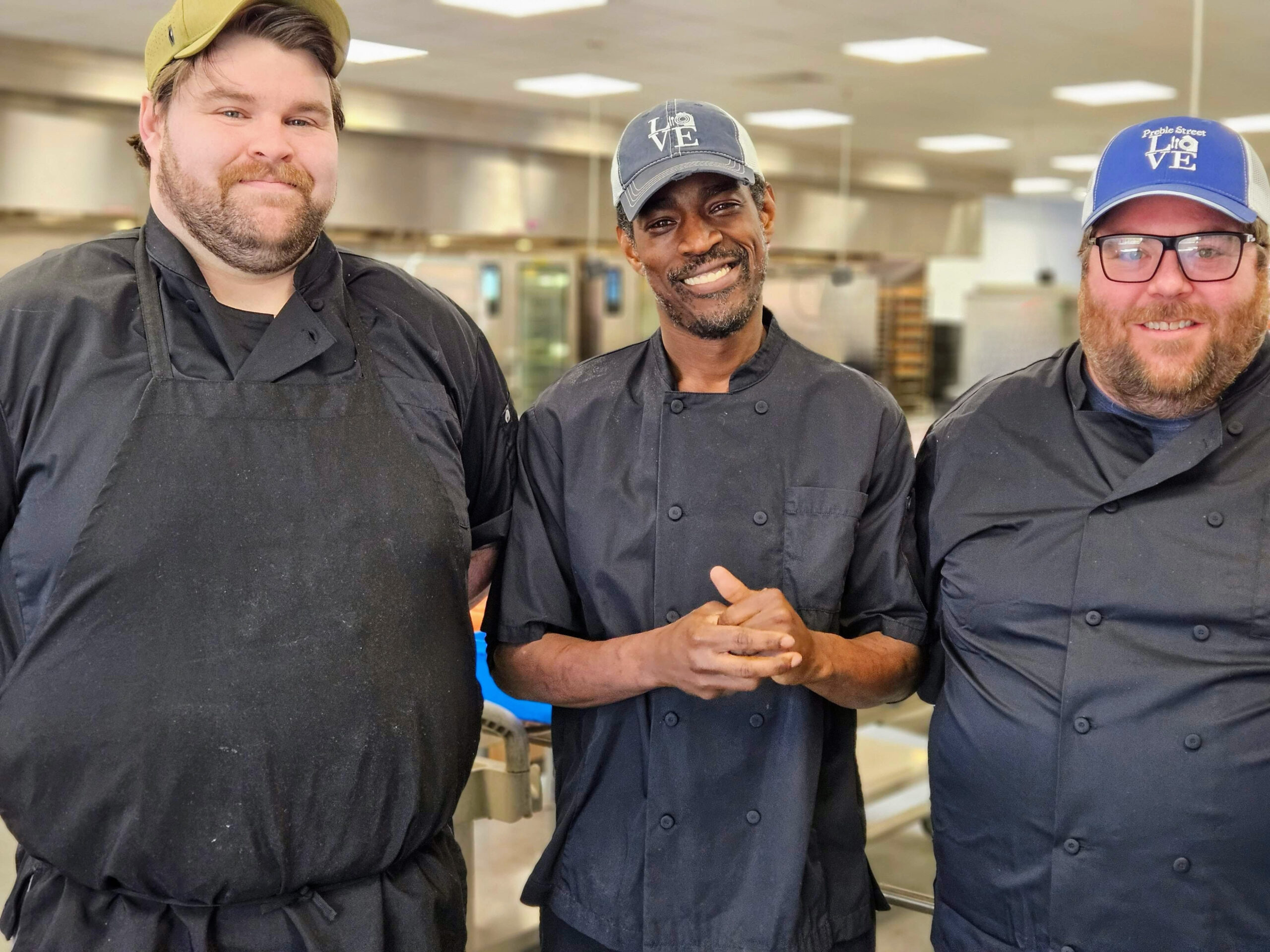

Meet the head chefs of the Preble Street Food Security Hub: Colin Freeman, Food Programs Community Partnerships Director; Romann Dumorne, Food Programs Preservation, Research & Development Director; and Brian Grossman, Food Programs Culinary Director.
On a blustery Tuesday in March, Chefs Brian and Colin roll out fresh dough for 500 dinner rolls as Chef Romann chops vegetables for the stock he’s brewing in the 80-gallon steam kettle. These three are the head chefs at the Preble Street Food Security Hub, where they lead a team of staff and volunteers in creating, preparing, and packaging thousands of meals every day for people experiencing hunger and homelessness in Maine.
“Everyone deserves to have a good plate of food. The three of us really believe that,” says Brian. “We all have backgrounds in fine dining and just like in our restaurant days we’re here to feed people good food. But now, we’re also here to make sure people get fed. It’s a different mentality. There’s no ego in it.”
Using local ingredients and innovative cooking techniques, they craft nutritious, tasty meals for people who are unhoused, as well as youth, families with children, older adults, Veterans, and immigrants and asylum seekers. Recent creations include:
- Chicken Harissa Ragu over rice with roasted butternut squash
- Beef Picadillo
- Chicken Chickpea Curry
- Shepherd’s Pie
- Veggie Frittata
Even with decades of experience between them, the chefs face challenges in these new roles.
“The biggest challenges are the sheer volume of meals we need to produce at a time, and the fact that we rely on what food is donated from our partners and local farms,” shares Brian. “We don’t usually know what’s going to come in, so while we can plan a little bit, whatever shows up is what we have to work with. That’s a big difference from the restaurant world where everything is thought out way ahead of time.”
“Once, over 500 pounds of cilantro arrived at our door, and we had to figure out how to turn that into a week’s worth of meals,” adds Colin. “I ended up making a sofrito that we are still using today in marinades, chili verdes, and salsas. We’ve also had to develop methods for stretching our limited proteins, which arrive in varying grinds and fat contents, and that we want to incorporate into as many meals as possible.”
When Preble Street first envisioned the Food Security Hub (FSH) in 2021, one of the goals for the 30,000 square foot facility was to prepare and store thousands of meals that could be on hand for natural disasters, pandemics, and other kinds of emergencies. Today, the FSH is designed to cook up to 10,000 meals daily with freezer capacity to store 50,000 meals, and the team there is carefully testing recipes and production to eventually meet that capacity.
“I always feel like everyone is supporting us, they’re rooting for us, and wanting us to reach those big goals,” says Romann. “I love being responsible for that. Our first goal is to have 10,000 meals stored, and the reason behind that is we don’t want anything sitting in the freezer too long. We send meals out fresh, but we also send out meals that we freeze. We taste test each meal after 1 week, 1 month, 2 months, 3 months in the freezer to make sure it meets our standards. As we build up these partnerships with agencies who need these meals, that food is moving now. Then we can start to try to get to the next level, which 20,000 stored meals.”
The FSH was just celebrating its grand opening in October 2025 when the SNAP crisis emerged with the threat that 170,000 Mainers would not receive SNAP benefits in November and thus not have enough food for their families. Immediately, the chefs jumped into action.
“It felt good to say ‘yes,’” shares Romann. “Preble Street leadership came to us and said, can we double the number of meals we’re making…starting tomorrow? We said yes, and we did it.”
“Exactly,” adds Brian. “We all have this huge belief that food is not a privilege. Of course, we’re going to react and say ‘yes, we can gladly do this.’”

Staff highlight: Tim Stokes – Housing problem-solving
Preble Street staff are #CompassionInAction, and we want you to get to know them! This month we’re introducing you to Tim Stokes, Case Worker, Rapid Re-Housing Program! How long have you worked at Preble Street? Since January 2025. What do you like best about your role? Everyone’s situation is different – but a stable housing arrangement often depends on many things coming together. I enjoy tracking down these things and connecting resources to help others regain a sense of autonomy.

Maine can make a difference for trafficking survivors
Please contact the Appropriations and Financial Affairs committee (AFA@legislature.maine.gov) today and tell them to provide $317,000 in one-time funding to support survivors of human trafficking in rebuilding their lives! Why is this funding important? Trafficking survivors in Maine urgently need support. In the coming days, Maine’s Appropriations and Financial Affairs Committee will consider whether to provide $317,000

Take Action: Tell Maine to provide permanent funding for emergency shelters!
UPDATE MARCH 10, 2026: Please contact Maine’s Appropriations and Financial Affairs committee (AFA@legislature.maine.gov) today and tell them to permanently allocate $5 million/year to sustain Maine’s 1,200 emergency shelter beds! — UPDATE FEBRUARY 24, 2026: Mainers experiencing homelessness need you to advocate for shelter funding now! After the public hearing and work session on the shelter funding bill